Translated from Maltese language.
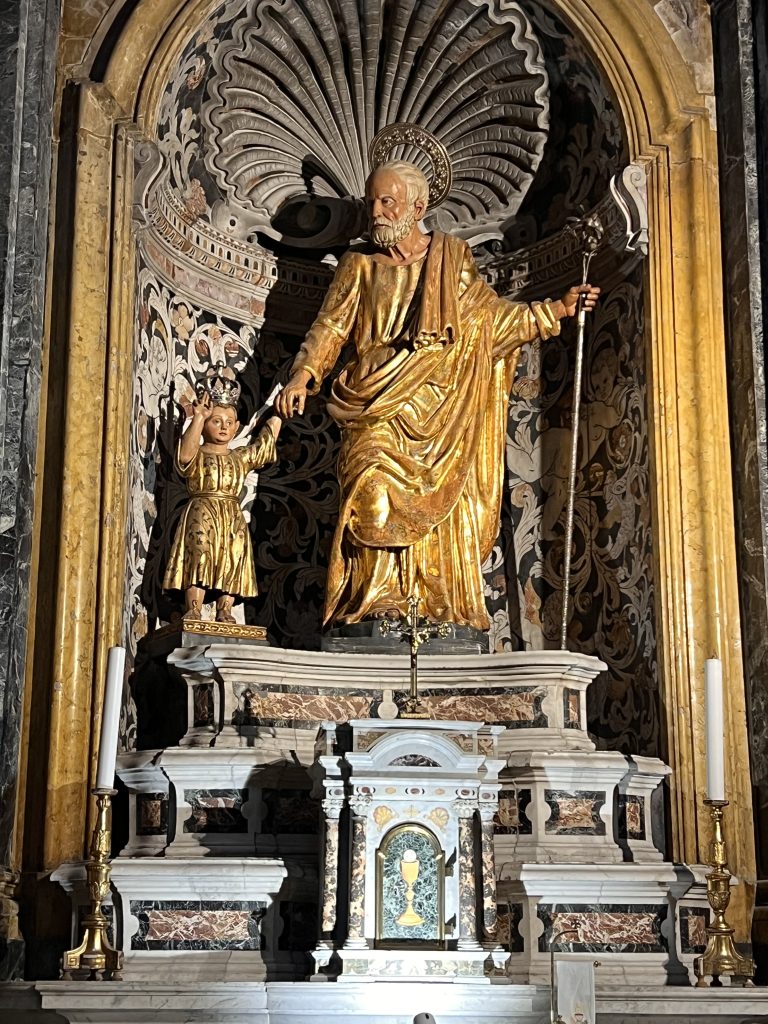
Saint Joseph in the teaching of Pope Francis
Saint Joseph has been a focal point of reflection for many Popes and theological studies, far too many to list within a single article. It may suffice to mention the Apostolic Exhortation of Pope John Paul II on the person and mission of Saint Joseph in the life of Christ and the Church. By contrast, the pontificate of Pope Francis began only in March 2013. The aim of this short article, therefore, is to consider Saint Joseph as an inspiration for Christian life in the light of Pope Francis’s works. Although only a few years have passed, it is still difficult to gather every reference to Saint Joseph here, and so the focus will be on the principal themes which, in my view, characterise this pontificate.
Pope Francis chose to retain the essential structure of the coat of arms he had already adopted at his episcopal consecration. In its lower section, alongside the star, traditionally symbolising Our Lady, there is also the spikenard flower, which represents Saint Joseph, Patron of the Universal Church. These images express, in my opinion, the heart of Pope Francis’s teaching, which consistently places Saint Joseph alongside Mary as a model for Christian life. He presents Joseph as a just man, but with a powerful message in favour of true justice that safeguards human dignity. Joseph not only observed the law but protected his wife Mary and, above all, Our Lord Jesus. Though silent, Joseph conveys a strong message of love, courage, and hope. He was kind without being weak. These, I believe, are the principal themes that emerge from Pope Francis’s teaching.
Social Responsibility
Pope Francis has issued two encyclicals. On 29 June 2013, Lumen Fidei (The Light of Faith) was published. Many argue that a first encyclical sets the tone for a pontificate and its direction.
“The faith in the Son of God made man in Jesus of Nazareth does not distance us from reality; rather, it enables us to grasp its deepest meaning, to understand how much God loves this world and continually guides it towards Himself. This leads Christians to commit themselves more fully and to live their earthly journey more intensely” (18).
Here we see how the Pope links the Christian’s duty with God’s love. In his second encyclical, Laudato si’ (24 May 2015), he again begins from God’s love revealed through Mary, but this time also connects it with the role of Joseph.
“Together with her, in the Holy Family of Nazareth, the figure of Saint Joseph stands out. He cared for and protected Mary and Jesus through his work and his generous presence, delivering them from the violence of the wicked by fleeing into Egypt. In the Gospel he appears as a just man, a diligent worker, and a strong figure. Yet from him also emerges a remarkable tenderness, which is not a sign of weakness but of true strength… He teaches us how to care, inspiring us to work with generosity and tenderness in safeguarding this world entrusted to us” (242).
In this encyclical, Pope Francis gives more explicit direction, expanding on a contemporary priority seldom addressed so directly in the Magisterium: the environment. One can appreciate here the importance of the Church’s teaching authority, as such a theme is not treated explicitly in Scripture. The Pope also connects environmental concern with economics, trade, labour, consumer culture, and values.
In his homilies, he further develops this idea of protection, how Joseph safeguarded the Son of God, as a model for safeguarding values, faith, and the Holy Family. In his homily at the Mass for the inauguration of his Petrine ministry on 19 March 2013, he said:
“With discretion, humility, and silence, yet with constant presence and complete fidelity, even when he does not understand… He accompanies every moment with care and love… in the journey to Bethlehem, in the anxious yet joyful hours of the birth, in the dramatic flight into Egypt, and in daily life at Nazareth, at the workbench where he taught Jesus his trade.”
Pope Francis continues by explaining that this protection extends to our own duties as Christians: care for creation, commitment to society, and above all the Eucharist as the source of our life and rooted in Christ’s command to love God and neighbour.
Joseph and Justice
Saint Joseph is commonly described as a “just man” (Mt 1:19), and so justice deserves particular attention. This reveals his integrity and fidelity to the law. Yet his sense of justice went beyond mere observance: he also showed compassion and courage, as when he took Mary as his wife and fled to Egypt.
A Christian cannot remain indifferent to injustice and evil. During his Apostolic Visit to Cuba, the United States, and the United Nations in September 2015, Pope Francis said:
“Joseph was a man who questioned himself, but above all a man of faith. Faith allowed him to find light when everything seemed dark… and to keep moving forward when everything seemed at a standstill.”
Joseph: Work as Part of Creation
Saint Joseph was a craftsman, according to tradition, a carpenter (Mt 13:55). Pope Francis builds on this, emphasising the dignity of work (so much so that the Church celebrates the feast of Saint Joseph the Worker). Reflecting on Joseph, he describes him as the “guardian of the mystery” and a man entrusted by God with a unique role in salvation history.
Joseph accepted this responsibility with simplicity and humility, revealing a deep spirituality. He did not seek recognition but became a father through his presence, his guidance, and his ability to nurture and pass on life and work to others.
Joseph in the Plan of Salvation
Jesus Christ is the fullness of God’s plan: The centre of all things. Faith cannot be taught in isolation but must be applied to our lives and salvation. God, who entered history through Christ, fulfilled His covenant with humanity through Christ’s death and resurrection.
Pope Francis highlights Joseph’s role alongside Mary in this plan. In an Angelus address (18 December 2016), he explains how Joseph, though initially confused, trusted in God and accepted Mary. In doing so, he welcomed God’s mysterious work with humility and obedience.
Joseph teaches us to trust in God and allow ourselves to be guided by Him with conscious obedience.
Conclusion
The pontificate of Pope Francis will surely be remembered for its emphasis on mercy and love. In this, he looks to Saint Joseph, a good and loving man and as a model. Just as Joseph chose love over strict legalism in accepting Mary, Pope Francis has opened the doors of the Church, reaching out to those on the margins of society, just as Christ did.
Coming from Latin America, where injustice is often widespread, Pope Francis challenges us: how can we be just, like Saint Joseph, if we do not speak about justice?
Undoubtedly, we will continue to see deeper and more beautiful reflections from Pope Francis on Saint Joseph in the years to come.
Serving without seeking attention
Christian teaching is always a source of guidance, especially in moments when we feel lost. In a world shaped by technology, immediacy, and the rapid spread of information through social media, the need for moral direction, and for reconnecting with our roots, is greater than ever. In His mercy and greatness, God allowed Himself to fully understand human struggles by choosing to become one of us. While under the care of the Holy Family, Joseph, together with Mary, served as a point of reference. Likewise, we too should look to Joseph as a guide, particularly when facing new and unforeseen realities.
What did Joseph do when confronted with the situation that Mary, whom he loved, would bear a child through the power of the Holy Spirit? What did he do to protect his son from Herod? As we know from the biblical account, Joseph was “a righteous man” (Mt 1:19). He observed the law, even registering his son in the Roman census, such that he was known as “Jesus of Nazareth, son of Joseph” (Jn 1:45).
Reflecting on these accounts and Joseph’s actions, three key points emerge:
a) Saint Joseph reflected deeply
b) Saint Joseph worked quietly, without fanfare
c) Saint Joseph was not afraid to act
In what follows, I will briefly explore these reflections, within the limits of this article, in the hope that they may be helpful in our daily lives.
Deep reflection
The spread of technology, especially mobile devices, the internet, and social media, has dramatically changed how we receive information. In journalism, there is now a frantic race to break news first, unlike in the past when the focus was on delivering well-crafted reporting. Sensationalism is ever-present. Some readers do not even read beyond the headline before commenting. Sounds and images often prove more appealing than reading, and books now compete with multimedia platforms.
While these developments have brought improvements, there is something essential we must preserve and nurture: the ability to think. And not just think, but think deeply.
Of course, the circumstances in Saint Joseph’s time were very different. Life may have been calmer, yet the challenges were no less significant. In the Gospel of Matthew, we read that an angel of the Lord appeared to him in a dream and said:
“Joseph, son of David, do not be afraid to take Mary as your wife, for what is conceived in her is from the Holy Spirit. She will bear a son, and you are to name him Jesus, because he will save his people from their sins” (Mt 1:20–21).
Everything suggests that Joseph reflected, discerned, and then made a decision. One can imagine that he also prayed with great faith. Had he not carefully weighed his decision, the consequences could have been severe. Even if interpretations of the law had become more moderate by his time, separation still carried serious civil or legal consequences for the woman.
Yet Joseph’s wisdom did not stop there. Having discerned his decision, he came to understand his role in the plan of salvation. As Saint John Paul II wrote in Redemptoris Custos (1989), Joseph not only heard the truth about Mary’s vocation but also about his own mission.
The key word here is “heard”. And to truly hear, one needs silence. In silence, we open our hearts to God. In silence, we also reflect and deepen our understanding. As Cardinal Mario Grech once observed, noise deprives us of the space needed to reflect, weigh ideas, and truly understand the messages and experiences we encounter.
Serving without drawing attention to oneself
Returning to the impact of social media, one cannot ignore the modern tendency to broadcast everything we do. Modesty is increasingly being lost. To be clear, technology itself is not the problem, it provides valuable tools for communication when used well. The issue lies in the diminishing sense of humility.
Here again, Saint Joseph offers an example: he worked quietly, without drawing attention to himself. In doing so, he remained open to others. As Pope Francis has said, Joseph’s silence reminds us that everything begins with listening; with stepping beyond ourselves to welcome the words and stories of others.
From this, we can draw two further reflections:
Firstly, God chose a humble setting to come among us. Joseph never sought recognition or status, yet he played a central role in salvation history. As Saint Paul teaches, the Church is one body, and its hidden members may be the most vital.
Secondly, to imitate Joseph means removing rivalry, greed for wealth and power, hostility, and the harm we cause one another. Instead, we are called to love, forgive, and act with charity, even in silence.
Taking action
At times, we may wrongly interpret Joseph’s silence as weakness. On the contrary, the biblical account shows his strength. He was not afraid to act, nor to do what was right.
When the angel warned him, “Rise, take the child and his mother, and flee to Egypt,” Joseph acted immediately, setting out by night. Later, he returned when it was safe. These were not easy decisions, yet he made them with courage.
This invites us to reflect: do we stand up for what is right? Do we defend those on the margins? Do we speak the truth, even when it goes against the current?
Good decisions are rooted in faith. Life often places us in difficult situations, where choices are far from easy. Joseph was able to act because he understood God’s will. Strengthened by this calling, he fulfilled a crucial role in the mystery of salvation.
Conclusion
These three reflections should not be seen in isolation and they build upon one another: thinking deeply, acting without self-promotion, and deciding with courage.
Saint Joseph is remembered not because he sought recognition, nor because his words were recorded, but because of his actions which are marked by prudence, courage, and obedience to God. These continue to inspire us today.
It is therefore fitting to allow the Lord to transform us. We conclude with a thought: what might have happened had Joseph chosen his own way instead of obeying God? Through his obedience, he protected the Saviour and played a vital role in God’s plan of redemption.